The 72-Hour Rule
In most hospitals there is an informal threshold that no policy document mentions but most deployments quietly obey.
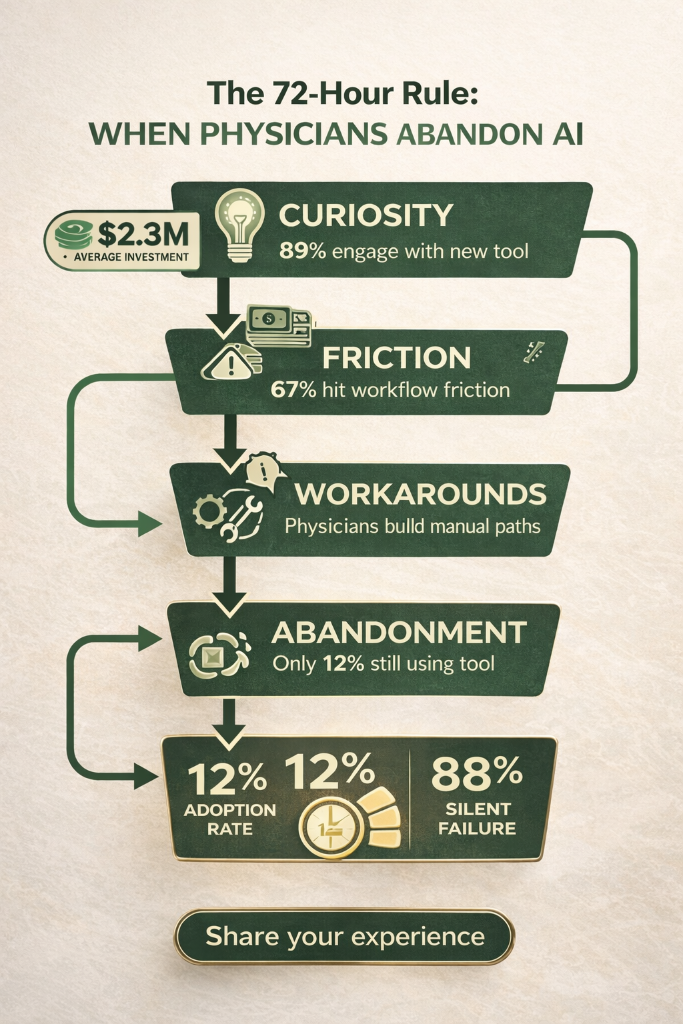
If a new AI system is not meaningfully incorporated into day-to-day clinical behaviour within roughly seventy-two hours, the probability of sustained adoption drops sharply.
The contract remains active. The system technically remains live. Metrics may continue to populate dashboards.
But cognitively, the tool has already exited practice.
Clinicians stop opening it unless prompted. Alerts are dismissed more reflexively than reflectively. Workflows revert to their prior state. No formal declaration of failure occurs. There is simply a quiet reallocation of attention.
This pattern has appeared repeatedly across deployments of predictive alerts, ambient documentation systems, second-screen copilots, and automated triage tools. Initial curiosity drives early interaction. Friction surfaces. Attention shifts. Usage stabilises at a fraction of initial exposure.
In multiple evaluations of electronic clinical decision support, override rates in live environments approach ninety percent. Post-deployment utilisation curves of several AI documentation and alerting systems show that fewer than twenty percent of intended users remain engaged after the first month without active intervention.
The interpretation that follows is usually immediate and rarely questioned.
The tool did not work.
That conclusion is attractive because it is simple. It protects workflow continuity. It preserves institutional hierarchy. It avoids confronting the possibility that the environment itself may not be designed to absorb certain forms of intelligence.
Over time, seventy-two hours has become an informal verdict window. It shapes procurement decisions, vendor survival, and internal narratives about technological readiness.
The number is not arbitrary. It represents the point at which novelty decays and friction becomes decisive.
The deeper question is whether those seventy-two hours are measuring the quality of the tool or the limits of the system receiving it.
That distinction determines what healthcare is willing to become.
Real clinical use surfaces workflows, edge cases, and actual ROI that demos never show.
Distinguishes between tools that transform practice and those that sound good in marketing.
Clinicians sharing honest reactions help the entire community make better adoption decisions.
Join the conversation: Share your 72-hour experiences with tools below. What worked? What disappointed? What surprised you?
No posts yet. Be the first to share your experience!